Showing posts sorted by relevance for query Seroquel. Sort by date Show all posts

Monday, March 02, 2009

Internal Documents Suggest that Seroquel Data Were Not Presented Accurately

A document dated March 9, 2000 titled "BPRS meta-analysis" shows that AstraZeneca, maker of the antipsychotic drug quetiapine (Seroquel), knew fully that its drug did not relieve schizophrenia symptoms to the same extent as its older, generic competitor haloperidol (Haldol). The document provides results of a meta-analysis, a statistical analysis that combines the results of several individual studies. The authors used the Brief Psychiatric Rating Scale (BPRS) as their main measure of efficacy. The BPRS rates a variety of psychiatric symptoms relevant to schizophrenia. More details on the BPRS can be seen here. A total of ten clinical trials were included in the meta-analysis, which variously compared Seroquel to placebo, Haldol, and several other antipsychotic medications. Four trials compared Seroquel to Haldol. Several subscales of the BPRS were included in the analysis.

When examining the amount of change on the BPRS, Seroquel consistently outperformed placebo, both on the BPRS total score and on several of the BPRS subscales. However, in several analyses, Seroquel was outperformed by Haldol and by risperidone (Risperdal; Janssen's antipsychotic). The document states: "Against 'all doses' of Seroquel, each of the three significant p-values generated was in favour of Haloperidol (Total BPRS, Factor V, and Hostility Cluster). There was no evidence of significant differences between the treatments when Haloperidol was compared to high-dose Seroquel." This is a plain admission that Haldol outperformed Seroquel on several outcomes, but that high dose Seroquel yielded approximately equivalent results to Haldol. Only one trial compared risperidone to quetiapine and the results clearly favored risperidone. The document stated: "Comparisons against Risperidone using all doses of Seroquel showed significant improvements for Risperidone on total BPRS, Factor V scores, and the Hostility Cluster. Against high-dose Seroquel only, the Anxiety item, Factor I, and Mood cluster scores were also significantly in favor of Risperidone." Risperidone beat Seroquel, and did so by a wider margin when a high doses of Seroquel was used.

The author of the document, Rob Hemmings, summarizes the results in a table, which appears below. It is described as such: "The following table is an attempt to simplify the claims that could be obtained from these results. A ✔ is entered for those comparisons where we have a statistically significant benefit, be it with 'all doses' or with high dose Seroquel... A x marks those comparisons where a comparator has demonstrated significant superiority compared to Seroquel."
The table demonstrates that according to an analysis by AstraZeneca employees, Seroquel is only shown to outperform placebo, whereas Seroquel is shown to demonstrate poorer efficacy than several other medications.

Under the heading "Conclusions," the document states, in part:
In terms of generating positive claims for Seroquel, these analyses seem somewhat disappointing. Although some trends in favour of Seroquel were observed in the Factor I and Mood cluster items, there was no evidence in these analyses of a significant benefit for using Seroquel over any of the active agents assessed."
The internal analysis clearly indicates that, based on several clinical trials, Seroquel offered no benefits over the competition in terms of reducing schizophrenia symptoms. Indeed, other drugs tended to outperform Seroquel.

How Can These Data be Managed? Shortly after the internal meta-analysis was completed, AstraZeneca employees discussed how to handle the negative results. An AstraZeneca publications manager, John Tumas, wrote in an email
The data don't look good. I don't know how we can get a paper out of this. My guess is that we all (including Schulz) saw the good stuff, ie the meta-analysis of responder rates that showed we were superior to placebo and haloperidol and then thought further analyses would be supportive and that a paper was in order. What seems to be the case is that we were only highlighting the good stuff and that our own analysis support the "view out there" that we are less effective than haloperidol and our competitors.
It would appear that an earlier analysis provided positive results which did not hold up during the internal meta-analysis. "Schulz" almost certainly refers to Dr. Charles Schulz, a psychiatrist at the University of Minnesota. In a press release from the year 2000, Dr. Schulz was quoted:
I hope that our findings help physicians better understand the dramatic benefits of newer medications like SEROQUEL because, if they do, we may be able to help ensure patients receive these medications first. The data suggest that SEROQUEL is an effective first- choice antipsychotic.
This press release was based on Schulz's presentation at the American Psychiatric Association convention in May 2000. The email from John Tumas discussed earlier noted that a group at AstraZeneca needed to meet soon "because Schulz needs to get a draft ready for APA and he needs any additional analyses we can give him well before then." It is unclear if Schulz ever received the analyses that showed Seroquel was less effective than Haldol. Regardless, in the press release, he was also quoted as saying: "Almost 50 years later, however, many patients are still taking these medications [such as Haldol], even though more effective treatments like Seroquel exist." While he was stumping for Seroquel in a press release, AstraZeneca's internal data painted a completely different picture.

Schulz, in his role as primary author, would typically be expected to demonstrate a solid understanding of the data underlying his presentation. It raises troubling questions when an independent academic author presents results that are in direct opposition to the underlying data. Such issues have been mentioned previously on this site.

The documents regarding Seroquel are available at Furious Seasons. Reporting on other facets of the documents can be found at the St. Petersburg Times, Bloomberg, New York Times, and the Wall Street Journal.

Friday, March 20, 2009

Seroquel, Haldol, and The Full Court Media Press

I was very pleased to have been acknowledged in a recent story in the St. Paul Pioneer Press. The reporter, Jeremy Olson, wrote the following in his story:

An Internet psychiatry blog first raised questions March 2 about the research Schulz presented at the APA conference and why it lacked any of the company's findings."It raises troubling questions when an independent academic author presents results that are in direct opposition to the underlying data," wrote the blogger, an anonymous academic.

He didn't cite my blog by name -- the unwieldy long name which I stupidly chose for the site may be responsible for that -- but I'm nonetheless grateful that my site was acknowledged for its work on this story. He is referencing my post in which I noted that a University of Minnesota psychiatry professor (Charles Schulz) had stated in a press release that Seroquel was "more effective" than Haldol. This was based upon his analysis of data comparing Seroquel to the much older antipsychotic drug Haldol in the treatment of schizophrenia. Yet an internal AstraZeneca analysis found that Haldol was actually more effective than Seroquel. Both the Pioneer Press and the Star Tribune, the two big papers in the Minneapolis-St. Paul area ran stories on the controversy.

When asked about his lavishing of praise on Seroquel in the press release, the Pioneer Press said:

In an interview with the Pioneer Press last week, Schulz defended his research and presentation of Seroquel as accurate and ethical. However, he acknowledged the corporate press release from his APA presentation might have exaggerated in calling Seroquel "significantly superior."

"You know," he said, "I can't disagree with that."

Schulz said the following in the Star Tribune:

In an interview this week, Schulz said the pharmaceutical company never shared its doubts about Seroquel, which went on to become a blockbuster, with annual sales of $4.5 billion today. "I don't recall anybody calling up and saying, oh my goodness, we have this problem," he said. At the same time, Schulz acknowledged that his own study did not really show that Seroquel was more effective than the older drug. "That's a bit of a misunderstanding," he said. "I think the overall message is that it works about the same."

Thanks to a helpful reader, I was able to track down what appears to be Schulz's presentation from 2000. It says "...quetiapine was clearly statistically significantly superior to placebo as well as to haloperidol..." This appears to contradict his statement that Haldol and Seroquel "work about the same." Again, the data from Schulz's presentation don't match AstraZeneca's internal analysis. Schulz is obviously backing away from his earlier praise for Seroquel, for which he deserves some credit. The problem was that Schulz, along with a laundry list of researchers in psychiatry were caught in a tidal wave of unbridled enthusiasm for the atypical antipsychotics, first as wonder drugs for schizophrenia, then as the Next Big Thing in bipolar, then moving into the world of depression and anxiety disorders in the absence of decent supportive evidence.

Interesting sidenote: While Schulz was presenting on the wonders of Seroquel, he was likely quite unaware that AstraZeneca has conducted a study (Study 15) which had found that Seroquel compared unfavorably to Haldol in preventing psychotic relapse among patients with schizophrenia who began the study in full or partial symptom remisison. Furious Seasons has some additional reporting on this study. It is a near certainty that Schulz was not informed about this study's results, as this could have changed his lofty opinion of Seroquel. This points to the problem of researchers relying on data collected by drug companies -- how are researchers to know they are receiving all of the data?

Note to key opinion leaders: If you don't realize it by now, you are pawns. You are being used to place an academic veneer on the marketing of drugs. The drugs that you are marketing as major breakthroughs typically offer little to no benefit over existing treatment and may cause a slew of nasty side effects. Decide if you want to be a scientist or a marketer. Don't try to do both at the same time, because the odds are pretty good that your scientific credentials will end up being tarnished. Just ask this guy. Now that the media are paying much closer attention to the conflicted interests and skewed science that sadly underlie much of psychiatry these days, it would be a good idea to maintain appearances.

Friday, February 27, 2009

Seroquel Becomes Zyprexa, Part 2. But With More Sex.

I had a big post on Abilify ready to go for today, but I'll sit on it for a few days because Seroquel is the new Zyprexa, and that is the big news of the week. Well, that and Forest getting probed for allegedly marketing Celexa and Lexapro off-label for depression in kids. But more on that later. In the meantime, check out Jim Edwards' nice piece on the emerging scandal.

Back to the 'Quel. First off, a big-time round of applause for Philip Dawdy at Furious Seasons. He's been covering the unfolding Seroquel mess like a hawk, which is exactly what he did during the days of the Zyprexa documents scandal, which is still costing the admittedly criminal corporation of Lilly billions. According to legal documents, Wayne Macfadden, former U.S. Medical Director for Seroquel, admits to being engaged in sexual relationships with a British researcher at the Institute of Psychiatry (IOP) who participated in Seroquel research. Incredibly, Macfadden was also apparently entangled in a sexual relationship with a ghostwriter who wrote up results of Seroquel studies. The attorneys who are suing AstraZeneca claim that: "The IOP researcher suggested that Macfadden would punish her if she even looked at studies that were favorable to Seroquel's competitors." Better yet, Macfadden was alleged to have "promised sexual favors in exchange for intelliegence on AstraZeneca's competitors." It would seem a relevant conflict of interest to note that one was engaged in sexual relations with the Seroquel Medical Director, wouldn't it? I don't typically care about people's sex lives and am in favor of respecting people's privacy. Except when it is potentially related to poor science and/or poor care of patients.

So that's a little weird. And then... according to the Wall Street Journal, internal documents from AstraZeneca suggest that AZ hid concerns that the drug caused diabetes. Gee, that sounds like a page from the Zyprexa playbook. AZ sales reps were instructed to inform physicians that there was no causal link between Seroquel and diabetes. However, according to the WSJ, "In a 2000 position paper about the safety of Seroquel sent to Dutch regulatory authorities, an AstraZeneca doctor named Wayne Geller wrote that there was a relationship between the drug and diabetes. 'There is reasonable evidence to suggest that Seroquel therapy can cause impaired glucose regulation including diabetes melliutus in certain individuals,' Dr. Geller wrote." Expect a few more stories to appear in the mainstream press followed by AZ doling out decent chunks of change to settle lawsuits. This may kill Seroquel's chances of FDA approval for depression, generalized anxiety disorder, and the common cold (OK, I made that one up). Let's hope the documents make their way to the internet so that bloggers such as myself and Philip Dawdy can dig through and go into more depth than the mainstream press. Just like we did with Zyprexa (1, 2, 3).

Can we call this the Sex-o-quel scandal or is that too cheesy?

By the way, Furious Seasons is currently running a fundraiser. I will be making my donation today, and you should do the same if you are in favor of mental health journalism that breaks important stories and is bold enough to cover a wide variety of important issues, regardless of their level of controversy.

Friday, February 09, 2007

Seroquel for Everything Update: GAD

I have mentioned earlier that Seroquel is being studied as a treatment for virtually every psychiatric disorder under the sun. You can now access a very brief outline of the latest Seroquel study for generalized anxiety disorder here.
The official title: An International, Multicenter, Randomized, Double-Blind, Parallel-Group, Placebo-Controlled, Active-Controlled Study of the Efficacy and Safety of Sustained-Release Quetiapine Fumarate (Seroquel SR™ ) in the Treatment of Generalized Anxiety Disorder (SILVER)
Virtually all big drug trials now have cute acronyms. Seroquel has used BOLDER before (here and here) and now it's SILVER. If only the academic researchers associated with these studies put as much thought and time into their work on the data analysis and writeup of these studies as the marketing teams did in coming up with the acronyms.

And how, exactly, did SILVER come from the above title? Seems like a stretch...

But wait, there's more.

Here's another study. In this one, Seroquel will be compared with placebo in the treatment of GAD in elderly folks. And still another study, this one apparently comparing Seroquel to placebo in the treatment of GAD, again. How about another one -- this one comparing Seroquel to Lexapro for GAD.

And another one -- this one apparently will put folks on Seroquel for a while, then follow those who show improvement. Some who improve will get switched to a placebo while some stay on Seroquel. If people switched to placebo show more anxiety, then AstraZeneca and its allied academics will say that Seroquel is a good long-term treatment. Of course, maybe it's just that Seroquel has withdrawal symptoms, and that is what caused the anxiety. Yes, this is all hypothetical, but it is the card that has been played time and time again for other psychiatric disorders.

Wednesday, February 14, 2007

AstraZeneca: Sued Over Seroquel

Over 10,000 US patients have filed lawsuits against AstraZeneca, alleging that AZ hid dangers of its bestselling atypical antipsychotic quetiapine (Seroquel). The lawsuits allege that AZ was not forthcoming about side effects such as significant weight gain and diabetes. In addition, the lawsuits focus on Seroquel allegedly being promoted for unapproved uses, a point I have suspected (here and here) for a while on this site.

Here's some snippets from the latest story from Bloomberg:

AstraZeneca said in a preliminary annual report filed Feb. 1 that it knew of about 1,200 lawsuits containing the claims of about 8,000 plaintiffs. The company ``has not determined how many additional cases, if any, may have been filed,'' AstraZeneca said in the filing. The company said in May it faced 232 Seroquel suits, including those with multiple claims.

--SNIP--

Seroquel, approved for use for schizophrenia and bipolar disorder, is part of a class of newer antipsychotic drugs including Zyprexa and Johnson & Johnson's Risperdal. Seroquel passed Zyprexa last year as the top-selling atypical antipsychotic, [AZ spokesperson] Minnick said.

AstraZeneca has been sued by 9,956 individuals in U.S. courts over Seroquel, according to a Feb. 5 filing in federal court Orlando, Florida, where the lawsuits have been consolidated in a multidistrict litigation for evidence-gathering and pre- trial hearings.

This includes claims by 7,171 plaintiffs in federal courts, primarily. The claims are made in about 1,500 lawsuits, many of which have multiple plaintiffs.

The suits claim that AstraZeneca knew the risks of Seroquel and didn't warn patients in the U.S. ``until they were finally forced to do so by the FDA,'' according to a complaint filed in federal court in Massachusetts, on behalf of 997 plaintiffs.

--SNIP--

The growth in sales of the drug, from $66 million in 1998 to $2.75 billion in 2005, was spurred by ``AstraZeneca's aggressive marketing of Seroquel,'' according to these patients, whose cases have been transferred to federal court in Orlando.

The marketing ``consisted chiefly of overstating the drug's uses and benefits (including massive off-label promotion), while understating and consciously concealing its life-threatening side effects,'' their complaint said.

Lawyers representing Seroquel users have agreed to limit the claims filed to people who said they developed serious health problems after taking the drug, said attorney Paul Pennock, lead plaintiffs' counsel in the multi-district litigation.

``Everybody involved took a blood oath that we were only going to pursue cases where there was a real injury, like pancreatitis, diabetes or severe exacerbation of existing diabetes,'' said Pennock of Weitz & Luxenberg in New York. ``This was as opposed to the Zyprexa litigation where a lot of people took on all comers,'' he said.

Pennock represents more than 1,700 plaintiffs, about 67 percent of whom were prescribed the medication for off-label uses, including insomnia, depression, anxiety, post-traumatic stress disorder and Alzheimer's, he said.

I'll be keeping my eye on this one. Given that AZ has been studying Seroquel as a treatment for virtutally everything, I strongly expect they "educated" physicians about the results from these studies on conditions other than bipolar and schizophrenia (which have yielded, from what I've seen, not overly impressive results) via doctor dinners, journal article dissemination, continuing medical misinformation, er, education, and the like.

Wednesday, November 15, 2006

Seroquel for Everything! (Except Weight Loss)

In Indiana, a recent story regarding Seroquel (which, as I've posted earlier, AstraZeneca is trying to get marketed for anxiety)...

"A Lowell couple is suing pharmaceutical giant AstraZeneca in federal court for failing to disclose the true dangers of its popular anti-psychotic drug Seroquel...

--SNIP--

"The lawsuit, filed last week in U.S. District Court in Hammond, says Randall Waugaman developed "diabetes and/or diabetes-related injuries" while taking the prescription drug.

Jim Minnick, a spokesman for AstraZeneca, declined to comment on the Waugaman's case, but said in general the company is disputing the claims in the swell of litigation filed in federal courts across the country.

"The safety of patients who use our medications is our highest priority," Minnick said Tuesday. "(Seroquel) is a safe and effective medication when used as directed as a prescribed medication."

Seroquel was approved by the U.S. Food and Drug Administration in 1997. A promotional news release says Seroquel is the most popular "atypical antipsychotic" prescribed drug in the United States, with global sales of almost $2.8 billion last year."

--SNIP--

Like many other litigants, the Waugamans claim that AstraZeneca covered up the results of its own studies on the drug that found it also could affect weight gain and hyperglycemia, potentially causing diabetes."

Well, well, well. Although it's fairly clear that Seorquel isn't a diabetes/weight gain inducer to the extent of Zyprexa, there is indeed evidence that Seroquel is often not good for one's weight (as can be seen here and here, among several others). Add this to additional lawsuits regarding the safety and marketing of Seroquel, and it makes one wonder if Seroquel will continue to be a cash cow.

Thursday, December 06, 2007

Seroquel for Everything and Academic Spokespeople

Part 1. Seroquel for Depression and Anxiety. AstraZeneca is slowly rolling out the PR for Seroquel as a treatment for depression and generalized anxiety disorder. At something called the 7th International Forum on Mood and Anxiety Disorders, AstraZeneca (via academic frontman Stuart Montgomery) has trotted out data from their latest clinical trials which purportedly show that Seroquel beat placebo for depression and GAD. Here's a quote from the detached, independent, non-conflicted academic author, Stuart Montgomery...
Dr. Stuart Montgomery, Imperial College School of Medicine, University of London and author of the [depression] monotherapy study, said: These study results are remarkable -- all of the doses of SEROQUEL XR examined provided improvements in MDD and GAD symptoms. Results from further studies that are still ongoing will add to our understanding of SEROQUEL XR in these conditions.
What is remarkable is not that 'Quell had a slight advantage over placebo but that an "independent" academic psychiatrist is willing to pimp Seroquel so blatantly. It would appear that Dr. Montgomery is aware of who is putting butter on his bread. Finding a modest to perhaps moderate advantage for a drug over a placebo in treating depression and/or anxiety is far from remarkable, given that there are dozens of drugs and psychotherapies that have demonstrated similar or better efficacy. Then again, it is remarkable that Seroquel is related to increased risk of diabetes (1, 2, 3, 4), which is likely not the case for competing depression treatments. Of course, since the movement has now started to treat depression with antipsychotics (1, 2), perhaps we will see many people with depression moving toward an increased risk of diabetes. It might be worth noting that on the MADRS, which was the measure of depression reported in the press release, one question is regarding eating -- the more you eat, the better your score. So an antipsychotic linked to weight gain is set to do well in that those who eat a lot will score better on this item, which is then taken as a sign that they are less depressed.

I've been tracking the Seroquel for everything bandwagon for some time now (1, 2, 3, 4) and I can't wait to see where this is headed next.

Part 2. The Academic Salesperson. As Krusty the Klown might say, "I heartily endorse this event and/or product"...

Here are some other Stuart Montgomery quotes from press releases:

Agomelatine
"Agomelatine is an interesting and potentially very valuable antidepressant that is effective in both moderate and severe depression", says Professor Stuart Montgomery from the Imperial College School of Medicine in London. "The new agent has a unique mode of action, improves sleep without affecting daytime alertness and its efficacy is not compromised by sexual side effects, tolerability problems or discontinuation symptoms.
Escitalopram (Lexapro)
"These results are important because they show we have a treatment at our disposal which is effective without sacrificing the good side-effect profile obviously preferred by patients," commented study author Professor Stuart A. Montgomery, Imperial College School of Medicine, London, United Kingdom. "The ideal combination for any first line treatment is good efficacy and good tolerability - this study shows that escitalopram has all the potency of the non selective SNRIs combined with the good tolerability of the conventional SSRIs," he concluded.
Lexapro (again)
“This consistent advantage really came out as a surprise,” marvelled Prof Montgomery. “These are shocking data that no one was expecting”. He added: “At that stage we already knew that there was something special about the drug”.

Finally, Prof Montgomery mentioned results coming from further studies that he referred to as “staggering” – these were decisive in establishing Lexapro’s long term effectiveness in treating both GAD and SAD.
One more piece on Dr. Montgomery may be of interest to readers (via The Guardian ):
A leading figure in the world of psychiatry gave a pharmaceutical company advice on how to get its new drug approved while he was sitting on the committee which was deciding the licence application.

An internal memorandum from Pfizer, the world's largest drug company, says Stuart Montgomery would be happy to become a paid adviser and declare an interest to the Committee on the Safety of Medicines (CSM) once the drug, an antidepressant to rival Prozac, had been through the licensing process.

Read the whole article and see what you think.

When Dr. Montgomery or other key opinion leaders with similar conflicts of interest speak, we are supposed to view them as independent expert researchers whose enthusiastic product endorsements are based purely based on science. The manner in which every drug company trot out eager academic spokespeople is a sign that academic medicine has become rotten to the core.

Friday, March 06, 2009

Seroquel, Weight Gain, And the Pursuit of GAD and Depression Indications

Jim Edwards at BNET dug through the Seroquel documents and found many instances of AZ employees noting that Seroquel causes weight gain. Yet the company seemed bent on keeping this information hidden. As I mentioned last week, this sure seems a lot like Zyprexa redux, except with more sex scandals and perhaps more buried data. I suggest that everyone head over to BNET and see the details.

Despite all the bad news, AZ is pressing onward with its application for FDA approval for Seroquel in both generalized anxiety disorder and depression. Yikes. I broke the story earlier this week about the "scientific literature" claiming that Seroquel worked better than Haldol in the treatment of schizophrenia, yet internal company data showed Haldol as superior to Seroquel in reducing schizophrenia symptoms. Between discrepant data, the apparent hiding of negative clinical trials and trying to keep doctors distracted from data indicating that Seroquel caused weight gain, I think that Seroquel's luck may have ran out -- my bet is that the FDA won't approve the drug for depression or GAD. But I've been wrong before; the FDA did approve Abilify as an add-on treatment for depression based on pretty flimsy evidence.

Sunday, July 01, 2007

Seroquel for Everything: Off-Label Marketing?

Peter Rost has a trio of documents on his site regarding potential off-label marketing of Seroquel. As you may recall, I promised to track the Seroquel lawsuit saga that I am fairly certain will continue to unfold. Why the lawsuits? Partially due to allegations of off-label marketing. The latest chapter, from Rost's site, is that AZ appears to have sent out a letter to sales representatives asking them to inform doctors about "medical education" events. As you probably know by now, "medical education" is quite often drug company-speak for "advertising." (1, 2, 3 ).

These "medical education" events were available via VHS, DVD, or webcast for doctors to view at their convenience. One event discussed Seroquel use in the young and the elderly, while another focused on Seroquel for bipolar depression prior to Seroquel receiving FDA approval for such an indication. Is that naughty? Yes. Is it illegal off-label marketing? I'm no lawyer, but I bet not.

Why? Well, the medical education was not provided by AZ. No, it was provided through a third party (i3 CME ), which was "supported" by AZ. i3 CME then found some key opinion leaders to provide "education" to their physician peers. The marketing message is laundered through i3 CME so that AZ can say, "We weren't marketing anything off-label -- we're not responsible for what i3 CME did with the program -- i3 CME is independent!"

Yeah, right. Should i3 CME wish to stay in business, they're going to make sure to get pro-AZ speakers and design a program that paints Seroquel in a good light. My favorite part is this snippet from the letter from the AZ CME director to sales reps.
AstraZeneca supported an independent educational activity on October 8, 2006 in the areas of "psychosis and dementia."
So if AZ supported an "independent" educational activity, doesn't that make the activity, um, not independent? Give me a break. For more on the Seroquel for everything saga, please read prior posts here and here.

Monday, November 20, 2006

Seroquel Clinical Trials Update

Over at Furious Seasons, you’ll find an excellent post about the clinical trial mania (pardon the bad pun) regarding Seroquel. Basically, Philip Dawdy went to the government’s clinical trials site and saw what was happening with Seroquel trials. The drug industry always talks about how much money it spends on research and development, yet if this is what counts as R & D, it is no wonder many people are not swayed by the industry that R & D consistently yields great new medications. Why develop new meds when you can just market existing drugs ad nauseum. Here are some of the trials that he found…


"Quetiapine (Seroquel) Maintenance Treatment in Early Onset Bipolar Spectrum Disorders" in 12 to 20 year olds

Quetiapine Fumarate (SEROQUEL) Compared to Placebo in the Treatment of Children & Adolescents With Bipolar I Mania" in 10 to 17 year olds

Quetiapine for Mania In Preschool Children 4 to 6 Years of Age With Bipolar Disorder" from the fine folks at Harvard Medical School

"Safety & Efficacy Study of Quetiapine Fumarate (SEROQUEL®) vs. Placebo in Generalized Anxiety Disorder"

"Quetiapine Augmentation for Treatment-Resistant PTSD"

I’d write more, but I’m not one to steal Dawdy’s well-deserved thunder on this one. Please read his full post. You’ll be glad you did. Since we’re talking about Seroquel, anyone want a sponsored editorial with that?

Friday, March 23, 2007

Seroquel for Everthing Update: WHAT??

AstraZeneca has reported that its trials with quetipaine (Seroquel) for generalized anxiety disorder and depression are going well, to the point that it plans on filing for FDA approval for said conditions in 2008. As you may recall, Seroquel is currently being studied as a remedy for, well, just about every mental condition (1, 2, 3, 4, 5). Here's what I'm betting is happening...

You conduct enough studies using a drug that is mildly better than a placebo, making sure to usually enroll a large sample of people. At least two of the studies will turn out to be "statistically significant" and who cares what happens in the other studies -- just don't publicize them or include them in your FDA application! If there are seven or eight studies examining Seroquel in depression currently, then we shouldn't be surprised if two of them yield somewhat better results for Seroquel. Considering that some depression rating scales rate an improved appetite as an improvement in depression, then Seroquel-induced weight gain actually counts in its favor.

Hat Tip: Furious Seasons

Monday, December 04, 2006

Effects the Size of BOLDERs

Spelling error in title intentional. I got my hands on the BOLDER II study, which found that quetiapine (Seroquel) was an effective treatment for bipolar depression. As is often the case in clinical trials research, I found something that made me feel uneasy. In the abstract it is stated that the therapeutic effect size (ES) was .61 for quetiapine 300 mg/d and .54 for quetiapine 600 mg/d on the Montgomery Asberg Depression Rating Scale (MADRS). The authors, however, used a different method to calculate effect size than what is typically done. This alternative method inflated the apparent effect of Seroquel by a decent margin. In this post, I’ll compare effect size done the conventional way to the effect size reported in the BOLDER II results.

If you’re not interested in how I calculated my stats, please skip the next paragraph!

I calculated the effect sizes from information available in Table 2 (pg. 604), where it is stated that, on the MADRS, 300 mg/d quetiapine was related to an average improvement of 16.94 points, while placebo was associated with an average improvement of 11.93 points. That nets a difference of 5.01 between the groups, according to my math. I calculated the standard deviation (SD) for each group from the reported standard error for each group: Standard error = (Standard deviation divided by square root of number of participants in the group). This gets a SD of 12.56 for the placebo group and a SD of 12.33 for the Seroquel 300 mg/d group. I then took the average of the two SD’s (technically, I weighted the placebo group a bit more heavily because there were slightly more placebo participants than Seroquel 300 mg/d participants). This yielded an average (pooled) standard deviation of 12.45. To get the effect size at this point, I divided 5.01 by 12.45.

On the MADRS, the effect size for Seroquel 300 mg/d versus placebo is .402. I assure you that the methods I used were those conventionally used in the field. The authors of the study, however, utilized mixed model repeated measures analysis (MMRM) to calculate their effect size. This is not conventionally how ES is calculated and an ES of .61 is obviously about 50% larger than an ES, calculated using conventional methods, of .402. The authors did not provide a rationale for using MMRM analysis to calculate effect size. When using an unusual method, an explanation should certainly be provided. My guess (and I could well be wrong) is that the sponsor took a look at how both methods turned out and decided that reporting the effect size using MMRM made better publicity. An ES of .61 is moderate according to most standards while an effect of .40 is often considered small to moderate. Through doing a newfangled analysis, the effect grows substantially and the drug looks more efficacious than it would had the more conventional method been utilized.

Hey, I’m all for progress. If MMRM is really a better analytic method, so be it. However, the study authors provided absolutely no rationale for using this analysis. They should have provided a rationale as well as providing ES calculated using both MMRM and traditional methods so that readers could have seen both figures. Instead, the higher ES’s are reported without any justification, leaving the reader thinking that there is no controversy regarding the reported effects of Seroquel in this study.

As for the 600 mg/day dose, my calculations come up with an ES of .37, which is again in the small to moderate category, whereas the authors came up with .54. The effect size goes up 46% this time when the unconventional method is used.

To summarize, the authors used an unconventional statistical method to calculate effect size, which resulted in effect sizes about 50% larger than those yielded when conventional methods are used. The results using conventional methods are not provided in the published report and no rationale is laid out for the unconventional method.

There’s more to come on my interpretation of BOLDER II. Stay tuned.

Saturday, February 24, 2007

Seroquel for Everything Update: Depression

Nothing like an antipsychotic for depression, eh? Well, apparently AstraZeneca is hoping that is the case. They are currently investigating Seroquel (quetiapine) as a treatment for depression.

On their clinical trials website, I noted eight studies currently (or in the near future) examining Seroquel for depression. Not bipolar disorder -- depression. One of these studies is recruiting exclusively elderly patients. This is just the latest in the Seroquel for everything campaign, which includes generalized anxiety disorder, alcohol abuse, public speaking anxiety, anorexia, and likely more. Can you say "Zyprexa: The Sequel"?

Are we really all that surprised that AstraZeneca is being sued for off-label marketing of Seroquel?

Saturday, December 02, 2006

Seroquel is Great...

And nobody paid me to say it [so it appears, misleadingly]...

Liz Spikol noted recently that Dr. Lakshmi Yatham was pimping Seroquel for bipolar disorder in a press release in which there was of course no mention that Yatham had served as a paid consultant for AstraZeneca in a number of capacities. Of course, the press release does mention that Dr. Yatham is the primary author of the Canadian Network for Mood and Anxiety Treatments (CANMAT) guidelines for treating bipolar [on which Seroquel is listed as a first-line treatment] and is a Professor of Psychiatry, University of British Columbia.

I'm not saying anything regarding Seroquel's efficacy for bipolar disorder -- I plan to discuss that at another time in the relatively near future. Further, I am not saying anything about Dr. Yatham's integrity; I am merely stating that the press release in question paints Dr. Yatham as an academic with no vested interest in Seroquel, which does not appear to be true. In many ways, this story is not a huge scoop, as many press releases feature academic authors who have undisclosed conflicts of interest. As you know, I'm not a fan of such misleading press releases, but I'm afraid they're here to stay. I am mainly writing about this because I am pleased as punch to see another blogger writing about a conflict of interest in the mental health arena. Thanks Liz and keep it up! Link to her posts on the topic here and here.

Tuesday, July 03, 2007

Quellin' in the Joint

I'm never sure how Ed at Pharmalot is able to keep up on literally everything drug-industry related, such as the recent story regarding the use of psychotropic medications in Vermont prisons. The latest story that I picked up from his site included estimates of 40 and 46 percent of the Vermont prison population being on some form of psychotropic medication. If either of those are close to correct, then I'm pretty sure we have a problem. In one Vermont prison, 20% of inmates were on Seroquel.

Perhaps that is not surprising in light of earlier research that Seroquel (or "Quell" as it is known in some correctional circles) is crushed and snorted in prisons and that some folks find it quite difficult to stop taking the medication. There have been other case reports indicating difficulties in patients discontinuing the Quell (1, 2 ). It was also reported (though it is unclear to what extent this is true) that some inmates request Seroquel because it gives them "a buzz."

And I thought Seroquel was just another "safe, gentle psychotropic..."

Monday, October 15, 2007

Son of Risperdal Beats Seroquel

Janssen, manufacturer of Invega (son of Risperdal) funded a study comparing Invega, Seroquel, and placebo in the treatment of schizophrenia. Results were as follows:
"After two weeks, those on Invega had a greater reduction in symptoms as measured by a standard test called Positive and Negative Syndrome Scale for Schizophrenia, or Panss. The test measures symptoms such as disorganized thoughts and uncontrolled hostility. The score for Invega patients declined 23.4 points, 17.1 points for Seroquel and 15 points for placebo, according to J&J."
By the way, note the rather paltry advantage of Seroquel in comparison with placebo. These results fit nicely into a pattern. A study published in the American Journal of Psychiatry in 2006 found that clearly, the best predictor of which antipsychotic would be shown superior in a head-to-head comparison was who funded the study. Also feel free to examine their table in which they point out the biases in these various comparative studies.

Pharma claims to spend bazillions of dollars on research -- but these studies aren't research in the classic sense, which is a scientific endeavor undertaken to gain knowledge. These are exercises in marketing -- set up a study with some sort of bias favoring your drug, then hurry and rush out the drug reps with low cut blouses and fistfuls of reprints of studies showing your drug is superior to the competition. Then, the competition retaliates by setting up a study in which their drug is set up to win due to some sort of biased design. And the cycle goes on and on and on. Pharma then counts these "studies" as research expenditures and waxes on about their dedication to developing lifesaving medications. As if these studies done purely for marketing purposes have anything to do with developing lifesaving medications.

Background on Invega:

Wednesday, May 09, 2007

Seroquel Lawsuits on the Rise

Lawsuits against AstraZeneca regarding its alleged failure to disclose the risks (like diabetes) of its drug quetiapine (Seroquel) are on the rise. Apparently, more than 350 cases were filed in Delaware state court in April. I'm not entirely clear if the latest lawsuits also allege off-label marketing, which is apparently becoming something of a calling card for AZ these days. Off-label marketing has been part of other Seroquel legal actions. No wonder, as it appears that Seroquel is being investigated as a treatment for, well, everything, as I've pointed out previously (1, 2, 3, 4, 5).

More details here.

Hat Tip: Furious Seasons and Pharmalot.

Thursday, February 08, 2007

Evidence Biased Medicine (To the Core)

The Last Psychiatrist wrote an excellent comment regarding a post describing how "scientific" data and/or its analysis and interpretation are often cooked by ghostwriters and/or friendly academics. He discussed how the whole process of publishing research is biased, a point that will be discussed in depth throughout this lengthy post. The Last Psychiatrist said:
Sure Pharma puts pressure on doctors, and forces through studies that are helpful to them (and suppresses those that hurt them).

But the real problem in medicine is the academic centers. Their bias is dangerous because it's so subtle and pervasive.

If Astra Zeneca does a Seroquel study, I think we can guess the bias. But when Assistant Professor Jones does a Seroquel study-- funded by the NIH-- is that study magically free of bias? What about Jones's beliefs on medications (he thinks pharmacotherapy is a gold mine, or is he anti-drugs and pro therapy?; maybe he's pro-seizure drugs (Depakote, Lamictal) and anti-antipsychotics (or the other way around?) Maybe his mentor gets AZ money (which is used to pay his salary through the university?) Maybe NIH has a stake in getting expensive drugs like Seroquel to look bad (e.g. CATIE?)

And journals are worse: think that the editors of a journal don't have biases-- even direct pharma ones?

And the three peer reviewers?

Ever wondered what articles don't get accepted for publication, and why (and I say this as someone who has a pretty high rate of publication success).

And why do those journals-- which publish public data-- cost $1000/yr and can't be accessed by the public?

The first and most important step to fixing medicine is abandoning the journal system. All articles, including the raw data that generated them, photos, scientific notebooks, etc, should go online. Let the world vet the data.
I agree with the great majority of what he said. I find it hard to believe that NIH is against expensive medications, since many of the NIH folks have ties with drug companies which are, of course, pushing newer and more expensive meds.

We have to keep in mind that the whole "scientific" peer-review process includes a lot of bias.

Let's review how studies go from a set of numbers into a published manuscript. It may sound like a dull process, but this is the foundation of our so-called evidence base in medicine, so it is actually very important to understand.

How is it biased? Let me count the ways...

Step 1. Analyzing data and writing the paper. Researchers transform a bunch of numbers into a paper.

1) It's anyone's guess as to whether the researchers have
actually seen the data upon which they are to base their writings. In some cases, it is unlikely that they have. So the company could have already made some alterations to the data -- it's unclear how often this happens, but it is certainly a possibility in some (hopefully rare?) instances.

2) The company can analyze the data in any way it sees fit.
Go to Aubrey Blumsohn's site for an excellent example of why this can be problematic. Company statisticians can cook the books either overtly or in a more subtle manner (like they did with the Seroquel data -- here and here).

3) The company can interpret the numbers in any way it wants.
For example, if someone committed suicide while taking a drug, the drug couldn't have caused it, but if the patient committed suicide on a placebo, then the placebo caused it. Even when the data are not favorable, positive conclusions are reached in most instances (here, for example).

4) The company can bury any unfavorable data.
Suppose that depression was measured in five different ways. If a couple of those measures yielded unfavorable results, toss them aside and act as if they never existed. Don't even mention that they existed in the article.

5) When all else fails, deep-six the study.
If the data still fail to prove favorable, just bury the entire thing -- don't publish it. When lawyers and/or researchers get their hands on unpublished data, it quite often shows unfavorable results which the sponsoring company thought best to bury.

Step 2. Peer Review. The paper is then sent off to "experts" for peer review. As the LP said earlier, these folks (including me) have their biases. Indeed, one of my peers has called the peer review process "a Rorscach test of the reviewers," meaning that you can easily see their biases through the reviews. Most reviewers of psychiatry journals have ties to industry which have likely shaped their beliefs to roughly the following: "Drugs are safe and effective," though biases will vary.

The comments of these expert reviewers are quite important in determining whether the study will get published.

Here's what one former journal editor, Richard Smith (British Medical Journal) had to say about peer review (with my emphasis):
The problem with peer review is that we have good evidence on its deficiencies and poor evidence on its benefits. We know that it is expensive, slow, prone to bias, open to abuse, possibly anti-innovatory, and unable to detect fraud. We also know that the published papers that emerge from the process are often grossly deficient.
Hmmm. No, this is not sour grapes on my part -- I've little to complain about in terms of being published. But myself and many other researchers are often befuddled by the whole process -- it often seems that reviewers are unhelpful.

Does peer review help, at least a little bit? I think so. Does it solve the problem of low-quality papers hitting journals, which are then turned into marketing copy by the drug and device industry? Obviously not.

Step 3. Editoral Decision. The editor chooses whether to accept the paper (usually after some revisions are made).

Journal editors frequently have huge ties to industry. Just google the names of many editors and you'll find that they have received funding from a lot of different sources. We also know that sometimes peer reviewers make good comments, yet the editor chooses to ignore them.

Note that nearly all journals are a for-profit entity. How can they make money? Advertising, subscriptions, and reprints. If a journal runs an article favorable to industry (saying that vagus nerve stimulation is great for depression, for example), then it is likely that the company will buy thousands of reprints for dissemination to physicians. The journal is making good money from each reprint and can make tens of thousands or even up to a million dollars from reprints of a study. A study that is unfavorable or irrelevant to industry is not going to generate revenue for the journal. So from a business standpoint, it makes more sense to print studies (like this or this) that are written from a slant of favoring a product than to run something less industry-friendly.

What to do?

Start by making all trial information publicly available.
The Last Psychiatrist said it. Richard Smith said it, and I agree with it. I don't think we should abolish journals altogether -- seems extreme, but making data publicly available -- that's an excellent idea.

Penalize those who engage in misconduct
As Fiona Godlee (editor of the British Medical Journal) stated recently:

So what can we do to change the blind-eye culture of medicine? In the interests of patients and professional integrity I suggest intolerance and exposure.

--SNIP--

And if journals discover authors who are guests on their own papers, they should report them to their institution, admonish them in the journal and probably retract the paper.

Reputations for sale are reputations at risk. We need to make that risk so high it's not worth taking.

Other thoughts?

Update (2-9-07): Quite a few people have been reading this via reddit. To see comments regarding this post at reddit, click the following link.

Friday, February 02, 2007

AstraZeneca Gone Wild


AstraZeneca is really pulling out all the stops in marketing Seroquel.

*First, there was the misleading marketing regarding Seroquel that got them slapped by the FDA.
*Let's also not forget about the new astroturfing campaign involving NAMI.
*Add in the clinical trials testing Seroquel for everything (here, here, here, and here). Once these trial results are published, look for Seroquel to be marketed (stealthily) off-label.
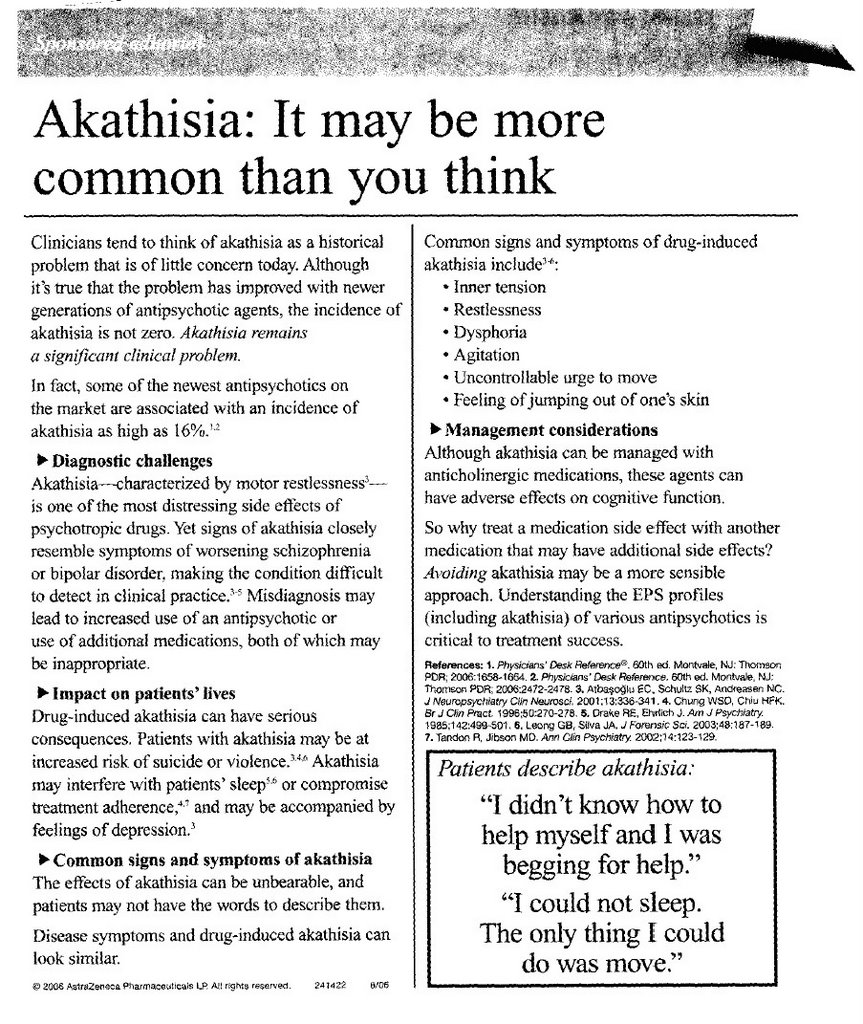
*And, of course, we have the sponsored editorials -- this time, it's the same one I mentioned earlier (here and here) and it appears in the January issue of the Journal of Clinical Psychiatry. As I've said before, it's well beyond unacceptable for an "independent" journal to run a sponsored editorial. Unbelievable.

I've got my own idea for a spot in a journal...
Stealth Marketing. It may be more common than you think.
You like?

Thursday, January 04, 2007

I NEED my Quell, Man!

Over at Furious Seasons, there is a great post about the possibility that for some, Seroquel might be addictive. Apparently, prison inmates are crushing and snorting Seroquel, or "Quell" as it's known in the clink. Ironic, given that Seroquel is being investigated as a treatment for addiction.

There have been a couple of documented cases of significant problems resulting from Seroquel withdrawal. Of note, there is very little research on any symptoms that may emerge as a result of discontinuing antipsychotic medication, especially for atypical antipsychotics. If nobody bothers to study the topic, then how would we ever know if "Quell" and perhaps some of its brethren cause nasty withdrawal effects? Of course, there's no money to be made by studying something as unsexy as withdrawal effects, so it probably won't be done.

There's much more over at Furious Seasons.