Showing posts with label AstraZeneca. Show all posts

Monday, March 02, 2009

Internal Documents Suggest that Seroquel Data Were Not Presented Accurately

A document dated March 9, 2000 titled "BPRS meta-analysis" shows that AstraZeneca, maker of the antipsychotic drug quetiapine (Seroquel), knew fully that its drug did not relieve schizophrenia symptoms to the same extent as its older, generic competitor haloperidol (Haldol). The document provides results of a meta-analysis, a statistical analysis that combines the results of several individual studies. The authors used the Brief Psychiatric Rating Scale (BPRS) as their main measure of efficacy. The BPRS rates a variety of psychiatric symptoms relevant to schizophrenia. More details on the BPRS can be seen here. A total of ten clinical trials were included in the meta-analysis, which variously compared Seroquel to placebo, Haldol, and several other antipsychotic medications. Four trials compared Seroquel to Haldol. Several subscales of the BPRS were included in the analysis.

When examining the amount of change on the BPRS, Seroquel consistently outperformed placebo, both on the BPRS total score and on several of the BPRS subscales. However, in several analyses, Seroquel was outperformed by Haldol and by risperidone (Risperdal; Janssen's antipsychotic). The document states: "Against 'all doses' of Seroquel, each of the three significant p-values generated was in favour of Haloperidol (Total BPRS, Factor V, and Hostility Cluster). There was no evidence of significant differences between the treatments when Haloperidol was compared to high-dose Seroquel." This is a plain admission that Haldol outperformed Seroquel on several outcomes, but that high dose Seroquel yielded approximately equivalent results to Haldol. Only one trial compared risperidone to quetiapine and the results clearly favored risperidone. The document stated: "Comparisons against Risperidone using all doses of Seroquel showed significant improvements for Risperidone on total BPRS, Factor V scores, and the Hostility Cluster. Against high-dose Seroquel only, the Anxiety item, Factor I, and Mood cluster scores were also significantly in favor of Risperidone." Risperidone beat Seroquel, and did so by a wider margin when a high doses of Seroquel was used.

The author of the document, Rob Hemmings, summarizes the results in a table, which appears below. It is described as such: "The following table is an attempt to simplify the claims that could be obtained from these results. A ✔ is entered for those comparisons where we have a statistically significant benefit, be it with 'all doses' or with high dose Seroquel... A x marks those comparisons where a comparator has demonstrated significant superiority compared to Seroquel."
The table demonstrates that according to an analysis by AstraZeneca employees, Seroquel is only shown to outperform placebo, whereas Seroquel is shown to demonstrate poorer efficacy than several other medications.

Under the heading "Conclusions," the document states, in part:
In terms of generating positive claims for Seroquel, these analyses seem somewhat disappointing. Although some trends in favour of Seroquel were observed in the Factor I and Mood cluster items, there was no evidence in these analyses of a significant benefit for using Seroquel over any of the active agents assessed."
The internal analysis clearly indicates that, based on several clinical trials, Seroquel offered no benefits over the competition in terms of reducing schizophrenia symptoms. Indeed, other drugs tended to outperform Seroquel.

How Can These Data be Managed? Shortly after the internal meta-analysis was completed, AstraZeneca employees discussed how to handle the negative results. An AstraZeneca publications manager, John Tumas, wrote in an email
The data don't look good. I don't know how we can get a paper out of this. My guess is that we all (including Schulz) saw the good stuff, ie the meta-analysis of responder rates that showed we were superior to placebo and haloperidol and then thought further analyses would be supportive and that a paper was in order. What seems to be the case is that we were only highlighting the good stuff and that our own analysis support the "view out there" that we are less effective than haloperidol and our competitors.
It would appear that an earlier analysis provided positive results which did not hold up during the internal meta-analysis. "Schulz" almost certainly refers to Dr. Charles Schulz, a psychiatrist at the University of Minnesota. In a press release from the year 2000, Dr. Schulz was quoted:
I hope that our findings help physicians better understand the dramatic benefits of newer medications like SEROQUEL because, if they do, we may be able to help ensure patients receive these medications first. The data suggest that SEROQUEL is an effective first- choice antipsychotic.
This press release was based on Schulz's presentation at the American Psychiatric Association convention in May 2000. The email from John Tumas discussed earlier noted that a group at AstraZeneca needed to meet soon "because Schulz needs to get a draft ready for APA and he needs any additional analyses we can give him well before then." It is unclear if Schulz ever received the analyses that showed Seroquel was less effective than Haldol. Regardless, in the press release, he was also quoted as saying: "Almost 50 years later, however, many patients are still taking these medications [such as Haldol], even though more effective treatments like Seroquel exist." While he was stumping for Seroquel in a press release, AstraZeneca's internal data painted a completely different picture.

Schulz, in his role as primary author, would typically be expected to demonstrate a solid understanding of the data underlying his presentation. It raises troubling questions when an independent academic author presents results that are in direct opposition to the underlying data. Such issues have been mentioned previously on this site.

The documents regarding Seroquel are available at Furious Seasons. Reporting on other facets of the documents can be found at the St. Petersburg Times, Bloomberg, New York Times, and the Wall Street Journal.

Tuesday, April 08, 2008

Bipolar Child Key Opinion Leader: I Get Money

As reported on the Wall Street Journal Health Blog, Dr. Melissa DelBello's tight financial ties to AstraZeneca are again under scrutiny. This should come as no surprise to my readers, as I noted in March that, in 2003-2004, DelBello had been the recipient of $180,000 from AstraZeneca (makers of Seroquel). I gleaned this information from results of an investigation by Senator Charles Grassley. The WSJ Health Blog noted that Grassley's investigation has continued, revealing that:
DelBello, who also has received NIH grants, also reported $100,000 in outside income between 2005 and 2007. But when Grassley asked AstraZeneca directly, the total value of its payments to DelBello during those three years came to $238,000.
So she claimed initially that she received $100k from 2005-2007, but she actually pulled in $238k from a single company and who knows how much from other outside entities. In fact, it is clear that DelBello has received funding from several other corporate interests. To quote her disclosure from a continuing medical education exercise:
Dr. DelBello has disclosed the following relevant financial relationships: AstraZeneca, Bristol-Myers Squibb, Eli Lilly, and Pfizer: Consultant; AstraZeneca, GlaxoSmithKline, Pfizer: Speakers’ Bureau; and Abbott Laboratories, AstraZeneca, Bristol-Myers Squibb, Eli Lilly, Janssen, Johnson and Johnson, Pfizer, and Shire: Research Support Recipient.
But wait, there's more! According to Grassley's investigation, DelBello has also established a company for "personal financial purposes." The company is called MSZ Associates and AstraZeneca put $60,000 in the coffers of the company. The address of MSZ Associates, according to Grassley, is the University of Cincinnati Department of Psychiatry (where DelBello works).

Again, as I've said earlier, I don't know Dr. DelBello, but from this information, I do indeed feel comfortable nominating her for a Golden Goblet Award. For background, read here and here. PharmaGossip's interesting visual representation of the situation can be seen here.

This is how one sets out to become a key opinion leader. DelBello quite likely has a mortgage and bills to pay, but is this confluence of commercial and academic interests really the best we can do for our patients?

Being a key opinion leader has one pleasant side effect: You Gets Mad Money.

(Warning: Video contains adult language)

Monday, November 26, 2007

Will the Antipsychotic Coverup Continue?

At this point, there are a slew of lawsuits facing manufacturers of atypical antipsychotics, from individual suits ranging to suits brought by state governments. Allegations of fraudulent marketing, kickbacks, and hiding research results are among the claims made in such suits. For example, Arkansas recently filed a lawsuit. Read it here and read my take here.

The most important thing that could come from these suits in the long run is not the money that various drug companies may have to shell out in fines. No, the important piece is the information, the internal documents that I am nearly certain document numerous instances demonstrating bad science, covering up negative data, and detailing ludicrous marketing campaigns. Check out the documents on Zyprexa over at Furious Seasons and you'll get a taste for what I mean. I've written about them on a few occasions (1, 2, 3) as have others, with one monster post from Furious Seasons serving as an excellent example. If such documents from all companies who have engaged in such ethically dubious practices were to become public information, the PR hit would be enormous. Hell, the media may even wake up and run numerous stories on this issue. Imagine: 60 Minutes, Panorama, NPR, Frontline, Now, and other news programs hitting this one hard on multiple occasions. And the complicity of academic psychiatry makes the story yet more fascinating.

As I mentioned recently:
Without academics pimping these treatments well beyond what was scientifically justifiable, these medications would never have achieved such huge success, but now this rather dangerous group of medicines is used for virtually every psychiatric disorder under the sun. These uses include "bipolar disorder" in infants, ADHD, and dementia. Let's put the most vulnerable individuals on the riskiest treatments despite no clear evidence that they work particularly well. There is indeed some evidence for the efficacy of these medications in the short-term treatment of schizophrenia and bipolar disorder, and in a small number of trials, even some long-term evidence of efficacy. But their indiscriminant use across the board for virtually every condition brings great shame upon psychiatry as a profession, on Big Pharma for its slick marketing strategies (1, 2), and most especially upon academic psychiatry for its morally bankrupt role as a group of salespeople who have misrepresented scientific findings to help promote drugs (1, 2, 3, 4, 5, 6, 7, 8).
But such hopes may well be fleeting. The various offending companies may just decide to settle these cases, which nearly always means that they get to keep their dirty laundry private. Here is a sad possibility mentioned by Furious Seasons:
Risperdal goes off patent in about one month--except for some extra and short-lived pediatric indications--so I'm not sure that Janssen/J&J has a huge incentive to fight Arkansas and the other states that are suing it in order to protect what is soon to be a generic product. It's likely much cheaper for the companies to settle the case (liability insurance will cover much of the cost), write an agreement in which they admit no fault and manage to deep six any documents and other evidence of bad behavior, and move onto Invega.

Zyprexa goes off-patent in 2011 and Seroquel is off-patent the same year as well (not sure about patents on Seroquel XR), so one wonders how much incentive those companies have to fight the state suits, or whether they will just settle the cases and move onto whatever is next for them.

Maybe I am a bit too cynical, but it wouldn't shock me if that's how things played out. After all, Lilly has already settled about $1.3 billion in lawsuits over Zyprexa. Why stop now?

Unfortunately, his prognostication is likely correct. Of course, if some insider at AstraZeneca, Janssen, Bristol-Myers Squibb, or Lilly (or Pfizer --though it seems Geodon has not received much legal attention) decides to leak aforementioned documents, then we're on to something. Consider this an open call to the insiders at said companies. Email me or Peter Rost or Philip Dawdy or Ed Silverman or Jack Friday (Pharmagossip). We're all currently accepting insider documents regarding such matters...

Friday, August 17, 2007

Amateur Sleuthing

The Wiki Scanner story is simply irresistible. Pharmalot let us know that AstraZeneca had changed the Wikipedia entry for Seroquel (story via the Times of London). Read more at Wired and Forbes. But, why wait around for a journalist to break the story when you can do it yourself? The Wiki Scanner site is a wonderful tool for amateur sleuths such as myself. Wanna see which companies made changes to Wikipedia entries? Here's just one example: Edelman PR made a change to the Wikipedia for Celecoxib (Celebrex) and for Viagra.

I'm far too short on time to continue this exercise, but I encourage all of you to hit the Wiki Scanner site and see what you can find.

Tuesday, July 03, 2007

Quellin' in the Joint

I'm never sure how Ed at Pharmalot is able to keep up on literally everything drug-industry related, such as the recent story regarding the use of psychotropic medications in Vermont prisons. The latest story that I picked up from his site included estimates of 40 and 46 percent of the Vermont prison population being on some form of psychotropic medication. If either of those are close to correct, then I'm pretty sure we have a problem. In one Vermont prison, 20% of inmates were on Seroquel.

Perhaps that is not surprising in light of earlier research that Seroquel (or "Quell" as it is known in some correctional circles) is crushed and snorted in prisons and that some folks find it quite difficult to stop taking the medication. There have been other case reports indicating difficulties in patients discontinuing the Quell (1, 2 ). It was also reported (though it is unclear to what extent this is true) that some inmates request Seroquel because it gives them "a buzz."

And I thought Seroquel was just another "safe, gentle psychotropic..."

Sunday, July 01, 2007

Seroquel for Everything: Off-Label Marketing?

Peter Rost has a trio of documents on his site regarding potential off-label marketing of Seroquel. As you may recall, I promised to track the Seroquel lawsuit saga that I am fairly certain will continue to unfold. Why the lawsuits? Partially due to allegations of off-label marketing. The latest chapter, from Rost's site, is that AZ appears to have sent out a letter to sales representatives asking them to inform doctors about "medical education" events. As you probably know by now, "medical education" is quite often drug company-speak for "advertising." (1, 2, 3 ).

These "medical education" events were available via VHS, DVD, or webcast for doctors to view at their convenience. One event discussed Seroquel use in the young and the elderly, while another focused on Seroquel for bipolar depression prior to Seroquel receiving FDA approval for such an indication. Is that naughty? Yes. Is it illegal off-label marketing? I'm no lawyer, but I bet not.

Why? Well, the medical education was not provided by AZ. No, it was provided through a third party (i3 CME ), which was "supported" by AZ. i3 CME then found some key opinion leaders to provide "education" to their physician peers. The marketing message is laundered through i3 CME so that AZ can say, "We weren't marketing anything off-label -- we're not responsible for what i3 CME did with the program -- i3 CME is independent!"

Yeah, right. Should i3 CME wish to stay in business, they're going to make sure to get pro-AZ speakers and design a program that paints Seroquel in a good light. My favorite part is this snippet from the letter from the AZ CME director to sales reps.
AstraZeneca supported an independent educational activity on October 8, 2006 in the areas of "psychosis and dementia."
So if AZ supported an "independent" educational activity, doesn't that make the activity, um, not independent? Give me a break. For more on the Seroquel for everything saga, please read prior posts here and here.

Friday, May 11, 2007

Subthreshold Bipolar: Media Blitz and Lilly

I posted in lengthy form yesterday about the newly legitimated "subthreshold" bipolar disorder (hereafter referred to as SBD) that 2.4% of Americans allegedly will develop during their lifetime. The press releases and "news" stories have predictably followed. Let's start with something called Medical Condition News. Prepare for some bad journalism...

The headline reads as follows: "4 percent of US adults have some form of bipolar disorder"

Sure, a newly minted disorder (SBD) that actually appears nowhere in the official diagnostic manual accounts for most of that, but whatever.

Here's how the news piece characterized SBD:

...a milder, sub-threshold bipolar disorder that involves hypomania with or without depression, otherwise classified as bipolar disorder "not otherwise specified" in the current diagnostic nomenclature of the American Psychiatric Association.

Except that SBD did not require hypomania -- SBD actually required more like half of hypomania. Note to journalists: Read the article, then write on it.

How about treatment? Here's what the article said:

However, over the previous 12 months, only 25 percent of those with bipolar disorder I, 15.4 percent with bipolar disorder II and 8.1 percent with sub-threshold bipolar disorder received appropriate medication

Remember, there is scant if any research on what appropriate medication is for bipolar II and there is not a damn bit of research attesting to medication for SBD. Remember, the article said that appropriate medication included mood stabilizers, antipsychotics, and lithium. Who cares that this is just pulled out of a hat?

Article 2
This one has appeared on a few different sites. Duck and cover.

However, only a few [who current were in an "episode"] received appropriate medication (25.0% for bipolar I, 15.4% for bipolar II, and 8.1% for subthreshold bipolar disorder). Appropriate maintenance medication for currently asymptomatic patients was even lower (17.9%, 15.6%, and 3.2%, respectively).

Again, this is suggesting that there is an appropriate medication treatment for bipolar II and SBD, when the data just ain't there. If the mainstream press jumps on this, this could be a big problem.

The Zyprexa Connection
The rich irony of this is that Lilly has been shamed by the disclosure of internal documents (like this one) showing that it pimped Zyprexa to primary care doctors for a condition similar to SBD. Apparently Lilly was just ahead of their time. Lilly must be shaking their heads -- they get negative media coverage while researchers have now just sneakily endorsed the treatment of watered-down bipolar disorder with... drugs like Zyprexa. Please read my earlier post to see how this all ties together. There was no science behind the treatment for faux bipolar when Lilly was offering it, and there is still no science behind it today.

Thursday, May 10, 2007

Subthreshold Bipolar: The Giant Sucking Sound

Just how many people have bipolar disorder AND what is the deal with “subthreshold” bipolar disorder? Research in the latest Archives of General Psychiatry attempts to answer just these questions. There is some strange stuff going on in this article. Suffice to say that if you hear a giant sucking sound – it is the sound of people with bipolar II and (worse) subthreshold bipolar disorder being sucked into long-term treatment with medications that lack evidence for their conditions. Warning: This is a long post. Read on…

Regarding prevalence of bipolar disorder in the US, the authors concluded that bipolar I has a one percent lifetime prevalence while bipolar II has a 1.1% lifetime prevalence. But 2.4% of people develop, at some point in their lives, “subthreshold bipolar disorder.” I don’t have major issues with how they assessed for bipolar I or bipolar II, but what, exactly, is the deal with subthreshold BP?

Well, here is their definition. To qualify for subthreshold BP, you must have had the following symptoms more than once:

A. A distinct period of persistently elevated, expansive, or irritable mood, lasting throughout at least 4 days, that is clearly different from the usual non depressed mood.

B. During the period of mood disturbance, two (or more) of the following symptoms have persisted and have been present to a significant degree:

(1) inflated self-esteem or grandiosity
(2) decreased need for sleep (e.g., feels rested after only 3 hours of sleep)
(3) more talkative than usual or pressure to keep talking
(4) flight of ideas or subjective experience that thoughts are racing
(5) distractibility (i.e., attention too easily drawn to unimportant or irrelevant
external stimuli)
(6) increase in goal-directed activity (either socially, at work or school, or
sexually) or psychomotor agitation
(7) excessive involvement in pleasurable activities that have a high potential for
painful consequences (e.g., the person engages in unrestrained buying sprees,
sexual indiscretions, or foolish business investments)

C. The episode is associated with an unequivocal change in functioning that is uncharacteristic of the person when not symptomatic.

D. The disturbance in mood and the change in functioning are observable by others.

Let’s play mix and match with these criteria.

So, if you have twice or more had a time when your mood was persistently irritable or high (A) and you didn’t need much sleep (2) and you felt pretty full of yourself (1), then you, my friend, qualify for subthreshold BPD. Or, if you, on a few occasions, were full of energy (A) and feeling much better than average (A) for, say a week, and your self-esteem was notably increased as well (1) and you got much more than usual accomplished (6) – then you also have subthreshold BPD. Let’s not forget that the second author has been saying for years that we exist on a “bipolar spectrum” with many cases of “soft bipolar” (subthreshold bipolar) being missed by unwary clinicians. Maybe he's right, but this type of definition does not give me the impression that "soft bipolar" is a big time problem.

Feel free to play more mix and match in the comment section of this post. I’m sure that most people diagnosed with subthreshold bipolar were more severely impaired than this, but these criteria are clearly too loose.

Oh, and when one goes to the comment section of the article (page 547), the authors state that their “prevalence estimate of subthreshold BPD is likely to underestimate bipolar spectrum disorder in the population”. Huh? That’s because their “definition of subthreshold BPD is still more restrictive than the definitions proposed by clinical researchers.” Oh, okay then. Because some researchers are willing to play even looser with their criteria, then we should just accept that there are a lot more people out there who have this so-called disorder.

The authors also looked at “severity of role impairment.” This analysis was based on people who had recently suffered from bipolar or subthreshold BPD. They found that among people with subthreshold BPD, 46% has “severe” role impairment, and 42% had “moderate” role impairment due to their “subthreshold mania”. Role impairment was defined as participants’ highest score of their impairment across four domains: home management, work, social life, and personal relationships. So if a participant scored no or mild impairment in three of four areas, but scored moderate on one area, then the person was counted as having moderate impairment. That’s what I call rounding up! I’d also like to see other some sort of other measure used besides this quickie disability scale. What were the real-life consequences associated with their subthreshold hypomania? That question remained unaddressed.

One other thing. On page 546, the authors state that the average number of “episodes” – either manic, depressive, hypomanic, or subthreshold hypomanic was 77.6 for those diagnosed with bipolar I, 63.6 for those diagnosed with bipolar II, and 31.8 for those diagnosed with subthreshold BPD. It strikes me that these numbers may as well have been pulled out of a hat. How the hell could somebody recall, in their life, how many “episodes” they’ve had and say, “Oh, geez, I think maybe 87.” I could be wrong, but I ain’t buying these figures.

Treatment: Warning – this is both sneaky and scary. The article goes on to essentially say that psychiatrists are much more apt to provide appropriate medical treatment for bipolar disorder than are non-psychiatrist physicians. It mentioned that those who had experienced “subthreshold” bipolar in the last year only received appropriate treatment 8.1% of the time. Earlier in the paper, appropriate treatment was defined as treatment with mood stabilizers (e.g., lithium), anticonvulsants (e.g., Depakote) and antipsychotics (e.g., Zyprexa, Seroquel, Risperdal). Rant on this to come in next paragraph -- it gets worse.

Now pay close attention. Only 3.2% of people who had a subthreshold diagnosis during their lifetime, but had not experienced an episode during the past year received “appropriate medication maintenance” treatment. WHAT?? Back up. There is scant, if any, data, saying that people with this newfangled diagnosis of “subthreshold” bipolar benefit from short-term treatment and there is not a *blanking* shred of evidence to say that people with “subthreshold” bipolar benefit from treatment with antipsychotics, mood stabilizers, or lithium in the long-term. How the hell did this section sneak through peer review? So it is now officially “appropriate” for people to receive Zyprexa or Seroquel for their “subthreshold” bipolar disorder in the long-term, even when they are experiencing no symptoms? Incredible. The paper also implies that people with bipolar II should receive constant treatment – again, where is the data to support such a recommendation. The long-term data on bipolar I treatment is also not great, but it dwarfs the data on bipolar II and “subthreshold” BP.

Funded By: The study was funded by various government agencies, the Robert Wood Johnson Foundation, and the John W Alden Trust. “Preparation of [the] article was supported by AstraZeneca.” As my astute readers know, AstraZeneca makes Seroquel, which is one of the “appropriate” treatments in this study. How does a company support the preparation of an article? Does this mean it was ghostwritten? I’m not accusing; I am just curious how a company would help to prepare an article? It would, after all, be to AZ’s benefit to suggest Seroquel was appropriate for people with “subthreshold” bipolar. Maybe I’m being too conspiratorial?

As I write this, I am thinking that I must have misinterpreted the article – there’s no way that the authors would endorse short-term and “maintenance” treatment for bipolar II and “subthreshold” bipolar given the lack of evidence. Please let me know if I misinterpreted something – I would really like to be wrong!

Hat Tip: Furious Seasons.

Wednesday, May 09, 2007

Seroquel Lawsuits on the Rise

Lawsuits against AstraZeneca regarding its alleged failure to disclose the risks (like diabetes) of its drug quetiapine (Seroquel) are on the rise. Apparently, more than 350 cases were filed in Delaware state court in April. I'm not entirely clear if the latest lawsuits also allege off-label marketing, which is apparently becoming something of a calling card for AZ these days. Off-label marketing has been part of other Seroquel legal actions. No wonder, as it appears that Seroquel is being investigated as a treatment for, well, everything, as I've pointed out previously (1, 2, 3, 4, 5).

More details here.

Hat Tip: Furious Seasons and Pharmalot.

Friday, April 13, 2007

AZ: The Plot Thickens

The gang of seven concerned employees as AstraZeneca march forward with more details concerning their allegations of off-label marketing. This one could really blow up into something large, if the facts are straight. Check out the latest from Brandweek NRX and Peter Rost.

Lest you forget, AZ also makes Seroquel, and the lawsuits have already begun about the, um, liberal, marketing of that product. More on Seroquel's ever-expanding market here and here.

Friday, March 23, 2007

Seroquel for Everthing Update: WHAT??

AstraZeneca has reported that its trials with quetipaine (Seroquel) for generalized anxiety disorder and depression are going well, to the point that it plans on filing for FDA approval for said conditions in 2008. As you may recall, Seroquel is currently being studied as a remedy for, well, just about every mental condition (1, 2, 3, 4, 5). Here's what I'm betting is happening...

You conduct enough studies using a drug that is mildly better than a placebo, making sure to usually enroll a large sample of people. At least two of the studies will turn out to be "statistically significant" and who cares what happens in the other studies -- just don't publicize them or include them in your FDA application! If there are seven or eight studies examining Seroquel in depression currently, then we shouldn't be surprised if two of them yield somewhat better results for Seroquel. Considering that some depression rating scales rate an improved appetite as an improvement in depression, then Seroquel-induced weight gain actually counts in its favor.

Hat Tip: Furious Seasons

Monday, March 05, 2007

Antipsychotics or Anna Nicole Smith?


California House Representative Henry Waxman, in his role as chair of the Committee on Oversight and Government Reform, has requested information from Lilly and AstraZeneca regarding their marketing of antipsychotics Zyprexa and Seroquel, respectively. AZ was further asked to provide information regarding its marketing of Actiq, a narcotic lollipop (!) and Fentora, a narcotic lozenge.

Information regarding the safety and purported off-label use of drug coated stents from Boston Scientific and Johnson & Johnson was also requested.

I’d like to point out that bloggers, including Philip Dawdy, myself, and Roy Poses, have written about the shenanigans associated with Zyprexa’s marketing while the major news outlets (except the New York Times) have remained stunningly silent. Perhaps Waxman’s latest move will revive the brain dead media from the fascination with Anna Nicole Smith, Britney Spears, and other stories that are completely unworthy of journalistic attention.

What, is that a blond celebrity with her breasts becoming unhinged from her top? Zy-what? Sero-who? Ugh.

Hat Tip: Furious Seasons.

Saturday, February 24, 2007

Seroquel for Everything Update: Depression

Nothing like an antipsychotic for depression, eh? Well, apparently AstraZeneca is hoping that is the case. They are currently investigating Seroquel (quetiapine) as a treatment for depression.

On their clinical trials website, I noted eight studies currently (or in the near future) examining Seroquel for depression. Not bipolar disorder -- depression. One of these studies is recruiting exclusively elderly patients. This is just the latest in the Seroquel for everything campaign, which includes generalized anxiety disorder, alcohol abuse, public speaking anxiety, anorexia, and likely more. Can you say "Zyprexa: The Sequel"?

Are we really all that surprised that AstraZeneca is being sued for off-label marketing of Seroquel?

Friday, February 23, 2007

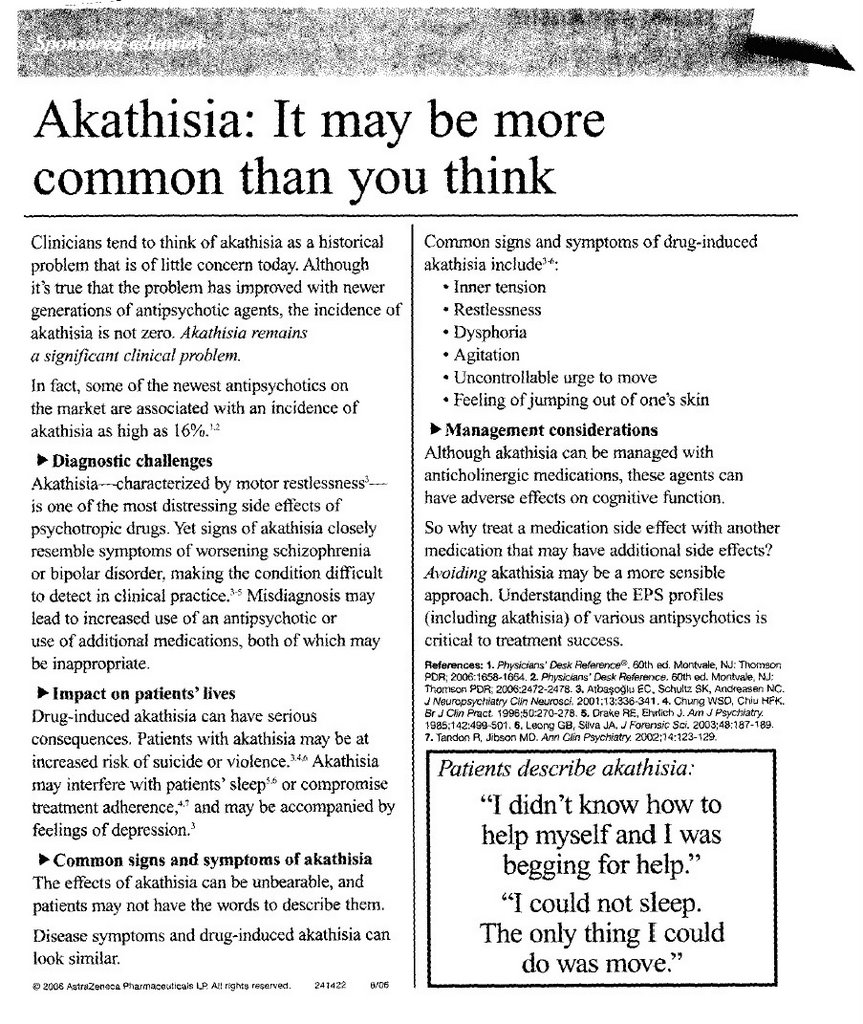
Return of the Sponsored Editorial

It's baaaaack! A reader informed me that the AstraZeneca-supported "sponsored editorial" which appeared earlier in the Journal of Clinical Psychiatry has now reared its ugly head in the January issue of Current Psychiatry.

As I've pointed out earlier, a sponsored editorial should never be allowed in a journal. If a journal is supposedly independent of its advertisers, how can an editorial (which reflects the opinion of the journal's editorial board) be sponsored? This same Seroquel advertorial has also appeared in the Journal of Clinical Psychiatry and, I suspect, in other psychiatry journals.

Friday, February 09, 2007

Seroquel for Everything Update: GAD

I have mentioned earlier that Seroquel is being studied as a treatment for virtually every psychiatric disorder under the sun. You can now access a very brief outline of the latest Seroquel study for generalized anxiety disorder here.
The official title: An International, Multicenter, Randomized, Double-Blind, Parallel-Group, Placebo-Controlled, Active-Controlled Study of the Efficacy and Safety of Sustained-Release Quetiapine Fumarate (Seroquel SR™ ) in the Treatment of Generalized Anxiety Disorder (SILVER)
Virtually all big drug trials now have cute acronyms. Seroquel has used BOLDER before (here and here) and now it's SILVER. If only the academic researchers associated with these studies put as much thought and time into their work on the data analysis and writeup of these studies as the marketing teams did in coming up with the acronyms.

And how, exactly, did SILVER come from the above title? Seems like a stretch...

But wait, there's more.

Here's another study. In this one, Seroquel will be compared with placebo in the treatment of GAD in elderly folks. And still another study, this one apparently comparing Seroquel to placebo in the treatment of GAD, again. How about another one -- this one comparing Seroquel to Lexapro for GAD.

And another one -- this one apparently will put folks on Seroquel for a while, then follow those who show improvement. Some who improve will get switched to a placebo while some stay on Seroquel. If people switched to placebo show more anxiety, then AstraZeneca and its allied academics will say that Seroquel is a good long-term treatment. Of course, maybe it's just that Seroquel has withdrawal symptoms, and that is what caused the anxiety. Yes, this is all hypothetical, but it is the card that has been played time and time again for other psychiatric disorders.

Friday, February 02, 2007

AstraZeneca Gone Wild


AstraZeneca is really pulling out all the stops in marketing Seroquel.

*First, there was the misleading marketing regarding Seroquel that got them slapped by the FDA.
*Let's also not forget about the new astroturfing campaign involving NAMI.
*Add in the clinical trials testing Seroquel for everything (here, here, here, and here). Once these trial results are published, look for Seroquel to be marketed (stealthily) off-label.
*And, of course, we have the sponsored editorials -- this time, it's the same one I mentioned earlier (here and here) and it appears in the January issue of the Journal of Clinical Psychiatry. As I've said before, it's well beyond unacceptable for an "independent" journal to run a sponsored editorial. Unbelievable.

I've got my own idea for a spot in a journal...
Stealth Marketing. It may be more common than you think.
You like?

Thursday, February 01, 2007

Scouts: Seroquel Plays Better on Turf

According to Pharmalot, AstraZeneca's antipsychotic (and, perhaps, anti-everything else) Seroquel may be moving towards being astroturfed, via the National Alliance for the Mentally Ill.

NAMI's press release on the topic states

The National Alliance on Mental Illness (NAMI) will significantly expand its support group program for people with mental illnesses to all 50 states and Puerto Rico by 2009, thanks to an exclusive multi-year partnership with AstraZeneca, LP.

Hey, maybe AZ is just doling out goodwill money, but I tend to think this is the following
a) Great PR for AZ
b) A chance to get more people introduced to the wonders of Seroquel

I suppose we'll find out. More on astroturfing here.

Hat tip to PharmaGossip.

Tuesday, January 30, 2007

Seroquel For Everything Update: Anorexia

A reader recently made the following comment about Zyprexa
Rumor has it that zyprexa is now going to be marketed for anorexic hyperglycemics....
I assume that this was sarcastic -- I got a chuckle from it, though I think the reader meant hypoclycemics. In any case, a study was recently published (Powers et al; International Journal of Eating Disorders) in which quetiapine (Seroquel) was used to treat people with anorexia. Mind you, this was an uncontrolled study, so the improvements in depression and other symptoms may well just be placebo effects. Here are the authors' conclusions, as seen in the study abstract:
Quetiapine was well-tolerated and patients had significant improvements in several subscales of the PANSS as well as decreases in measures of anxiety and depression.
Hey, it's just a matter of time before we can perhaps all benefit from some Seroquel in the water supply, right? I wonder how many reprints AstraZeneca has purchased of this ever so rigorous study to disseminate to physicians and to discuss at those (in)famous doctor dinners. Background here and here.

Monday, January 29, 2007

Seroquel for Everything: Update

You’ve surely seen me point out earlier that I’m more than slightly concerned with the proliferation of Seroquel (quetiapine) to treat virtually everything. What started out as an antipsychotic medication has spread into bipolar (with the help of some tricky statistics, naturally), then into being investigated for alcohol abuse, bipolar in preschoolers (assuming, of course, such a disorder actually exists!), generalized anxiety disorder, and now…

Fear of Public Speaking. Yep, Furious Seasons has just documented that the good folks at AstraZeneca are now aiming for people who are socially anxious. Hey, next time I’m feeling nervous prior to a conference presentation, I’ll make sure to pop one of these bad boys. Give me a break.

I can sense a fear of public speaking “disease awareness” campaign being planned at AstraZeneca’s corporate office as I type…

Thursday, January 25, 2007

BOLDER Statements

In this post, I will discuss statements of a couple academic thought leaders regarding the BOLDER I study and how these statements compare to the actual evidence.

Cutler: Dr. Andrew Cutler, one of the authors on the BOLDER I study to which I referred earlier, had some nice things to say about the study’s findings in Clinical Psychiatry News. For example, he said “It’s a landmark study.” In addition, the article paraphrased Cutler as saying, “The study used one dose each evening, and had several other unique features, he noted. Almost all previous data on treating bipolar depression focus on bipolar I patients, but this study included rapid cyclers and bipolar II patients.”

What Dr. Cutler failed to note is that Seroquel was not more effective than placebo at the end of the eight week trial for bipolar II patients. If Cutler is going to introduce bipolar II participants into the mix, then he has an obligation to mention that treatment was not significantly more effective than placebo for this group. He may have been misquoted – I don’t know – but it does read directly like PR for the drug that goes well beyond the findings of the study which he is discussing.

It is worth noting that Cutler runs a private research firm and that it can’t hurt his standing among drug companies who hire his firm to run clinical trials when he makes statements such as those mentioned above. I found it interesting that on his firm’s website, it is mentioned “We are also noted for low placebo response.” How do you get a low placebo response besides not treating participants very well? I’m not making an accusation – I am just really curious. If placebo response has to do with expectations of getting better and these expectations are influenced by how the study personnel treat participants, then what’s the deal? Maybe you can treat participants well and still quash the placebo response; I just wish I knew more about how this was done.

Calabrese: Dr. Joseph Calabrese, BOLDER I’s primary investigator, had the following to say about the study: “There was a dramatic response within eight days of beginning treatment in patients who were symptomatic with bipolar depression.” I’m not sure if “dramatic” is the right word. Looking at Figure 2 in the article, I see that after week one, placebo patients seem to have changed by 5 points on the Montgomery-Asberg Depression Rating Scale (MADRS), while those on Seroquel seem to have changed by about 9.5 points. That’s an average difference of about 4.5 points on a rating scale where the average patient had a score of about 30 coming in. So is a score of 25 (on placebo) “dramatically” different than a score of 20.5 (on medication)? Methinks that the language itself is a little dramatic. Don’t get me wrong – it’s good that the medication was better than placebo after a week. But let’s not get hyped up beyond what is reasonable.

It is troubling when academics are willing to make PR statements that go beyond the evidence and, in Cutler’s statement regarding bipolar II, are demonstrably false. Academic thought leaders are frequently featured in news articles, review articles, PR releases, and continuing medical ‘education’ events making these types of statements that go well beyond the evidence. It seems that too few professionals in the mental health arena have picked up on the fact that marketing and science have largely melded into a witches’ brew in which what is good for a product’s sales often trumps the actual data on its efficacy and safety.

Before anyone gets upset because I mentioned people’s names here, keep in mind that I’m not saying either Cutler or Calabrese is a “bad person.” I don’t know them personally. They may well conduct top-notch research and possess saintly personalities. All I am talking about here is how their remarks seem to differ from the studies that the remarks are based upon, and how such practice is widespread.

Major Hat Tip: Depression Introspection.